
There are places on this earth where the veil between the seen and the unseen becomes porous. For me, one such place is Odisha, a land that does not merely preserve Tantra in its stones, but breathes it through its soil, air, and river. I embarked upon a journey to the eastern part of India as part of the Shiva–Shakti tour. Our earlier travel as a group had taken us through the ancient temple towns of Tamil Nadu, but this year, the path led us to Odisha. What began as a visit with a small group of dedicated Sri Vidya sadhakas, brought together by serendipity and shared interests, turned out to be far more than a pilgrimage. It became another turning point in my life.
Our journey began with a visit to the Jagannath temple in Puri. I arrived in Odisha with no particular expectations. It does not fall within my familiar ambit of Shakti worship, and so I assumed my response would be one of an observer. I was unprepared for the impact of the famed Jagannath temple, even from a distance. The scale of the architecture, and the unmistakable force of its energy were palpable even from afar. The temple is a long walk from the parking area, and the easiest way to reach the precincts of the temple is by hiring an open rickshaw. This ride through the narrow lanes of Puri was, unexpectedly, a test of faith. First, we had to deal with the rickshaw drivers competing fiercely for passengers, voices raised with tempers running high. Some of these drivers resorted to open aggression, deflating a rival’s tyre even as we are all watching. There is no courtesy here, no illusion of civility, only the hard economics of hunger and daily earning playing out in a holy town.
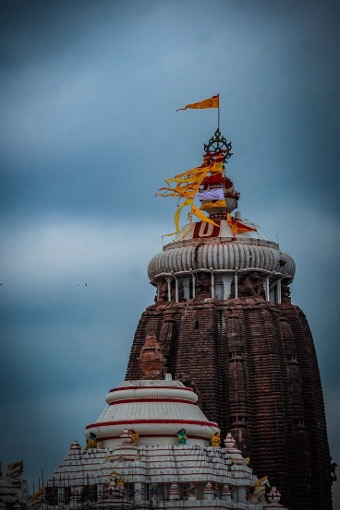
The lanes through we which we rode were cramped and noisy. The road was less a road and more a series of potholes loosely connected by intention. Every few feet, the wheels dipped and lurched, and at any moment, one misjudged turn could send us straight into a stagnant puddle, brown with rain and slush. And yet, this was Puri. A sacred town. A place associated for thousands of years with holiness, a Char Dham, where every Hindu is called upon to visit at least once in a lifetime.
The contrast is jarring. One moment you are holding the idea of spiritual bliss in your heart; the next, your body is bracing itself against a violent jolt, your mind calculating whether you will arrive in one piece, undamaged from an accident. Sri Vidya, Shiva, Shakti and the lofty language of transcendence felt very far away from these lanes where life was stripped to its bare mechanics.
But perhaps that is the teaching. That spiritual life is not lived in the sterile environs of a hermitage or ashram. It is not felt in the silence of a nature-filled forest or riverside on a mountain. It is tested in chaos, in discomfort, in the inability to control the world around us. Faith in Odisha was not a feeling of calm. It was a test to see if we could stay open and unresentful while everything outside was conspiring to unsettle.
Once we enter the sprawling temple campus, we are surrounded by relentless crowds, pushing, shoving, bodies pressing into bodies, this chaos is simply a way of life here. There we are in the sanctum sanctorum, just moving with the wave of humanity pushing us along and forward. I don’t even remember how I got close to the altar, when all of a sudden, the head priest reached out, held my hand, and drew me right up to the rope that separates the deities from the devotee. Now I am so close to the mighty Jagannath and the priest is asking me my name but I could not remember. My gotra – no recollection. As if my mind is completely blank, my identity dissolved and only feeling a presence that is vast and all consuming. The rest of the day is a blur. All I remember is the feeling of intense connection with the Source.
On the following day, we visited the Chausath Yogini Temple at Hirapur, one of the oldest and rarest surviving Yogini temples in India, dedicated to the worship of the sixty-four Yoginis. Located about twenty kilometres from Bhubaneswar, the temple stands on the banks of the Bhargavi River, far removed from the bustle of the city and charged with an unmistakable ancient energy.
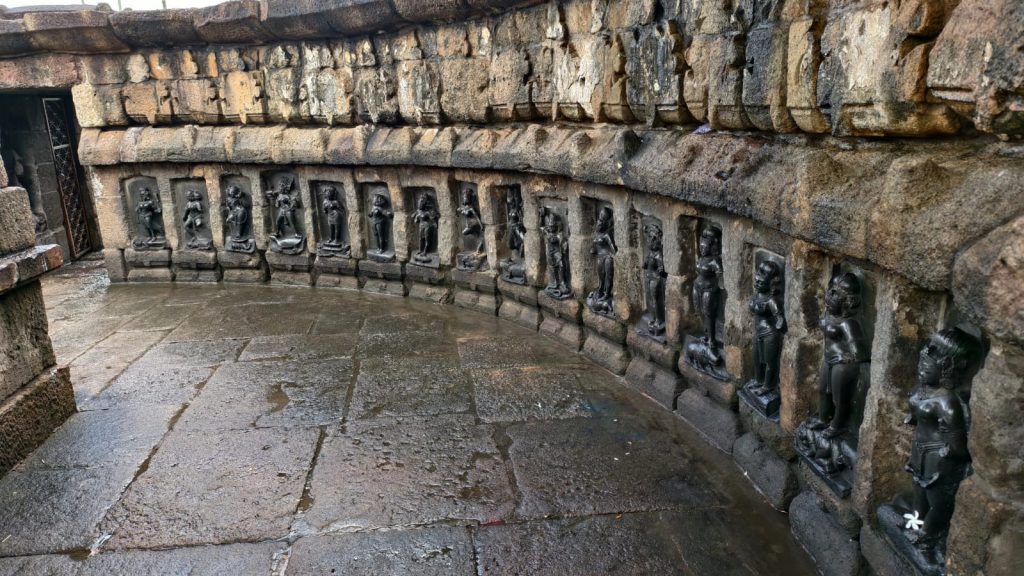
Architecturally, the temple is a powerful expression of tantric cosmology. Built as a circular, roofless (hypaethral) structure in sandstone, with low enclosing walls, it signifies worship in the bhumandala, the field of the five elemental forces. Along the inner circumference are niches for the sixty-four Yoginis, of which only fifty-six to sixty remain today. Open to the sky, the temple invites direct communion with the elements, while its circular form evokes a living mandala, a sacred geometry through which cosmic order is both represented and experienced.
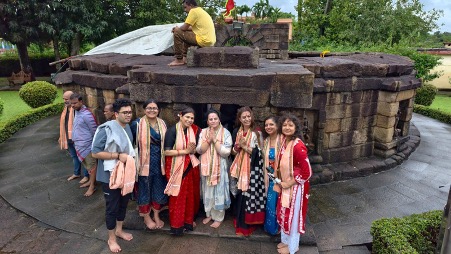
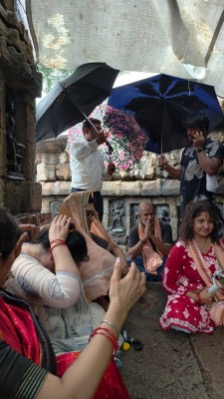
We had arranged for a yajna to be performed inside the temple by a local priest, known as a panda. As we arrived at the temple, Odisha reminded us of its elemental temperament. The weather turned fierce, sharp winds and sheets of rain met us head-on and we were left wondering how the yajna that we were all anticipating would take place. There was no panic in the group, only an intuitive recognition that this, too, was part of Devi’s grand plan for us on this tour.
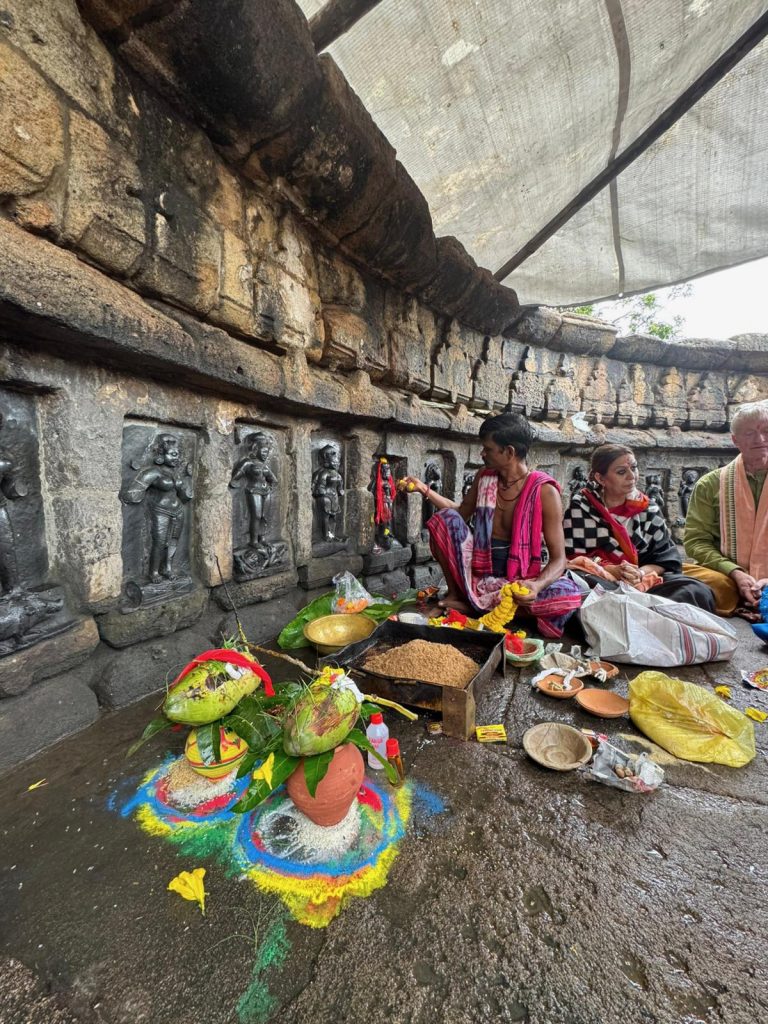
Instinctively, we recalled a line from the Lalita Sahasranama, Daurbhagya tula vatula jara dwanda raviprabha, which speaks of Ma manifesting with the force of a cyclone, sweeping away the devotee’s misfortune which is so insignificant that it is likened to a mere wisp of cotton. Standing within a roofless tantric shrine, surrounded by Yoginis, with the full force of wind and rain bearing down upon us, that verse ceased to be a metaphor. It became a lived experience as the rain drenched us even as the yajna was taking place with some temporary covers put in place to shield us from the forces of nature. On three occasions, the rains stopped and the sun shone brightly enough for our clothes to become completely dry and the fire ceremony was somehow completed, against all odds.
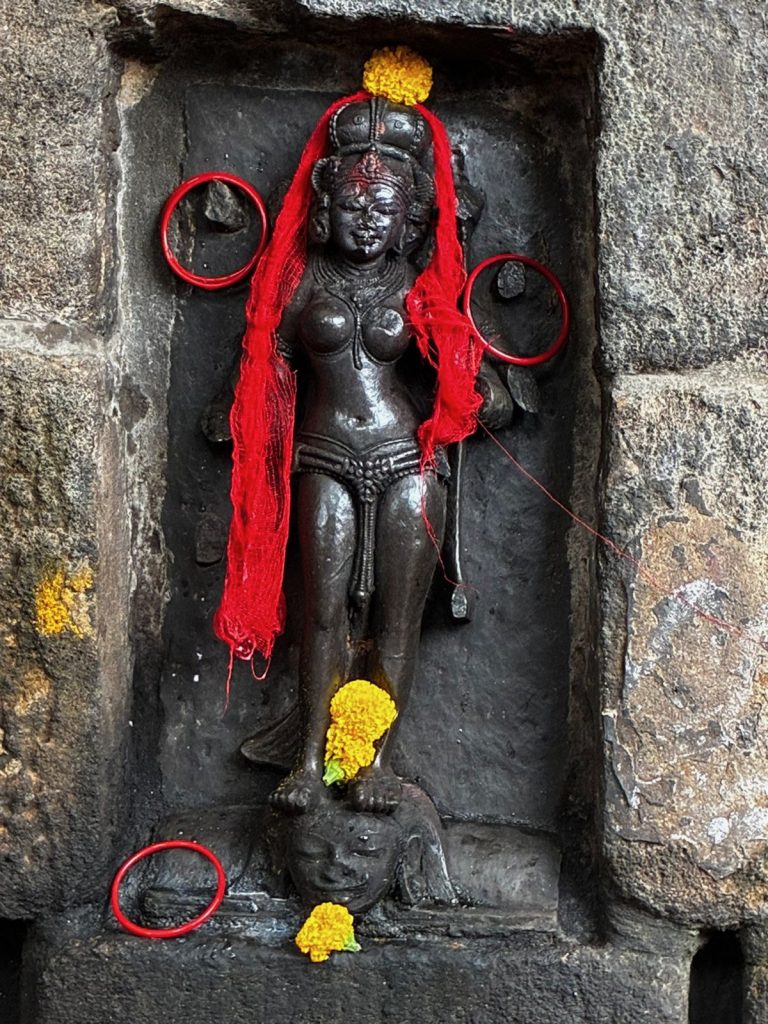
The panda chose the idol of Chinnamasta as the main deity for the yajna. All the idols in this temple are desecrated with faces and body parts mutilated and this is from the time the temple was documented in the 20th century so it is a confirmation that the damage was already centuries old. The panda placed red bangles on the idol where the hands had been chopped off and decorated the space with flowers and a red cloth. When I later asked him why he had chosen this specific deity over other more popular ones such as Ma Chamunda (who is depicted as a skeleton, with an emaciated body and sunken abdomen) and Ma Varahi (depicted with the familiar boar head and riding on a buffalo), he replied that many in the group needed to propitiate Rahu and Ma had called upon him to dedicate this pooja to Chinnamasta. In Vedic astrology and Tantra, Chinnamasta is strongly associated with Rahu, the shadow planet, serving as a powerful remedy for Rahu’s malefic effects, symbolizing the breaking of illusions and desires that Rahu magnifies. Worshipping Chinnamasta helps mitigate Rahu’s negative influences, he added.
In those moments while the yajna was taking place, with the panda chanting mantras associated with Chinnamasta and the other Dasa Mahavidya devis, the rain and wind felt less like hindrances and more like revelations. The cyclone was a reminder that Devi’s grace does not always arrive gently. Sometimes it appears as an upheaval, clearing what no longer serves us, leaving behind a deeper stillness in its wake.
The next temple on our list was the very reason I had come to Odisha, to get a darshan of my beloved Ma Varahi at Chaurasi. I had heard of this temple from many people I guide, but one sadhaka’s experience has stayed with me with unusual clarity. He spoke of a time when he was on his deathbed, having exhausted all medical options. With nothing left to do, he prayed, not to any specific deity (he was not born a Hindu), but simply to the Source, asking for a peaceful passage into the next realm.
He described what followed as a dream or a vision. He was not sure. He saw a divine face, round, smiling, blissful and felt a touch upon his forehead, and that face guided him to behold a form he could not name. Blue-skinned, with the face of a boar, She stood commanding a vast army. The air thundered with the chant “Hum Hum” as weapons were struck against the ground in unison. The faces in that army bore thick, prominent moustaches, just as the asuras are described in our shastras. Soon after, he awoke with that image etched into his mind. Against all expectation, he went on to make a full recovery and eventually returned to a normal life.
Five years later, he reached out to me after hearing about my Varahi sadhana. It was during that conversation that I first heard the name Chaurasi. He later sent me a detailed article on the temple, which planted the seed of a future visit, little knowing that the woman who organizes the Shiva–Shakti tour (herself an accomplished sadhaka) had already placed this very temple on our itinerary.
The group was silently excited as we made our way from Puri to Chaurasi. The small town is located about 30 kms away from Konark and the drive took us through lush green paddy fields surrounding us. As we neared the temple, there was a palpable shift in energy and everyone started chanting the Varahi Moola Mantra. The green fields gave way to a more forest like ambience. We were in the midst of a path filled with large palm trees and dense foliage bringing to mind a vast, forbidding jungle. The temple is well hidden and not visible until we are in front of the gate. The first sight is of well-kept lawns with some shrubs and trees offering a lovely contrast to the sand stone architecture. As we got off the bus, I was utterly mesmerized as I felt the pull of Ma and headed straight towards the temple without waiting for the rest of the group to alight. As I entered the gate and climbed up the few steps I I saw that a big lock on the gate which leads into the hall of the temple. Thankfully, this gate which is made up of bars allow us to see all the way to the murti even when closed and I got my first glimpse of Ma Varahi. Since no artificial light is allowed within the temple, all I could see were the glinting eyes on a slightly angled face, almost as if they are made up of mercury, shining and beckoning with a gentle stare, welcoming me as if to say “so you have come, finally”!
There was a fleeting moment of disappointment at the locked gate mainly because of the group’s anticipation but even as they all gathered in front of the temple, two pandas arrived on the scene. One of them, presumably the senior of the two, looked straight at me and said: I saw you yesterday at Chausath Yogini temple and knew you would come today. We entered the temple, not believing our good fortune at this divine timing and already the energy was overwhelming us all. Most of the group found themselves crying uncontrollably as we witnessed the pandas chant a Bengali prayer before concluding it with an arati that showed us Ma’s facial features clearly as the light fell on Her. We were then allowed to enter the Garba Gruha one by one to be close to her, touch the murti and to seek Her blessings. By the time we were all done with our prayers, there was a collective feeling of utter surrender, a peace had descended upon us so much so the entire group mirrored my thought: “Ma, take me now. I belong here. I cannot go back to the world as I have finally found my home.”
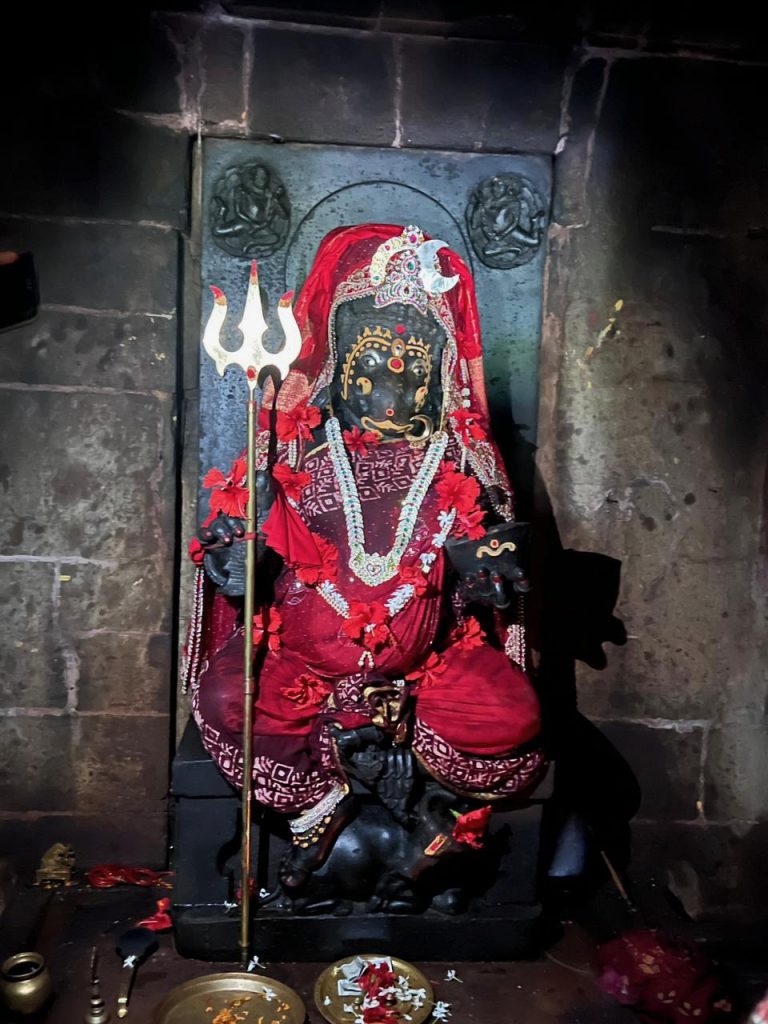
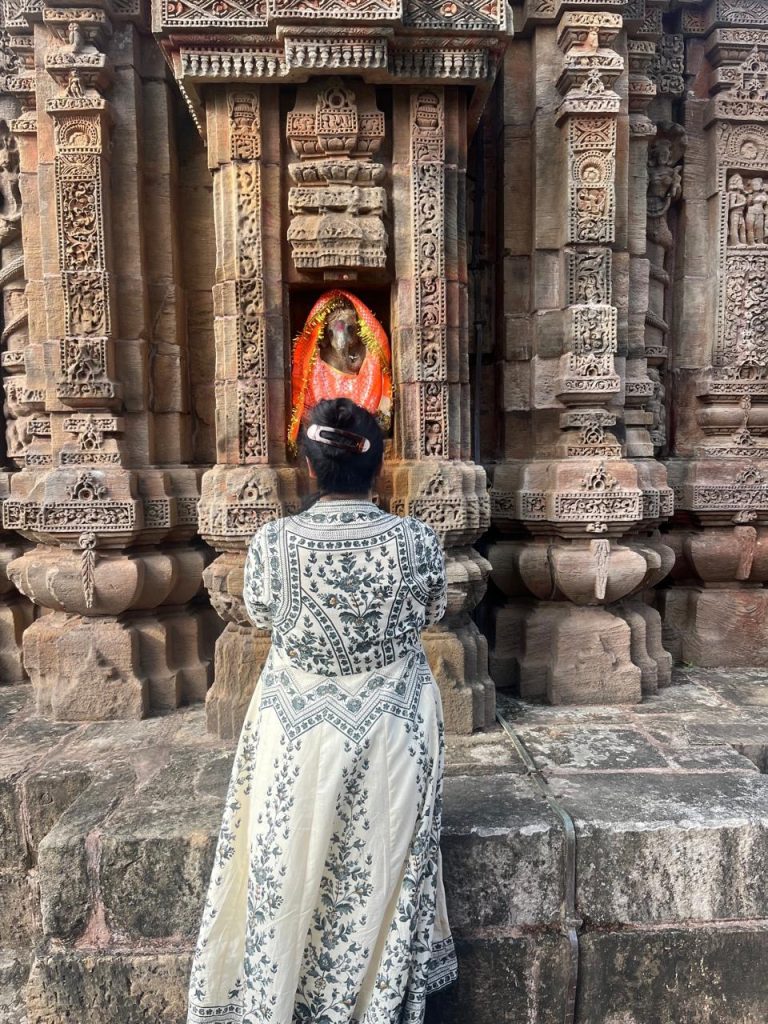
The idol in this temple which measures a larger than life 6 ft. 1 inch in height and 2 ft. 9 in. width, is said to be from the ninth century and is called Matsya Varahi as she is shown holding a fish in her right hand and a kapala (bowl) in the left. She is shown seated in Lalitasana on a pedestal. Her face resembles a boar but the body is of a woman. Here Ma Varahi is represented with a third eye on her forehead which is not clearly visible in the darkness. The idol is decked in finger rings,anklets, valayas, armlets, necklace,large ear studs and a tiara over the hair which ises upwards in spiral coils. Her right foot is on her Vahana, the buffalo which is seated on the pedestal at the bottom. When we had her darshan, she was dressed in a saree with added jewellery, holding a trishul and interestingly, she wore a pair of shiny anklets which the panda told us had been gifted that very day by a renowned sadhaka. In some pictures which are available with the ASI, she is shown with a big belly to indicate her as holding the universe in her womb (Bhugarbha Paranesvari Jagaddhatri) and perfectly rounded breasts depicting her as the Universal Mother. On the back slab two Vidyadharas are represented on either side of her murti.
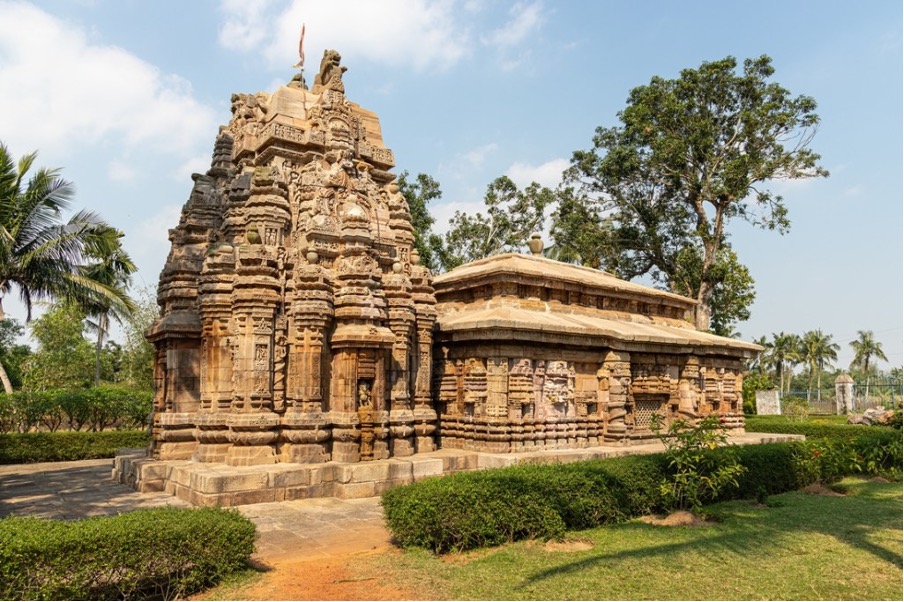
The temple was built around the idol in the 10th century by the Somavamsi rulers and experts agree that this temple is an example of mature Odishan sacred architecture. The inside of the temple consists of a small hall and the sanctum sanctorum while the outside is richly decorated with sculptures of various deities including Ganapati, Nagas, Surya devata and others. Considering the fact that it is such an important temple dedicated to Ma Varahi, we were all surprised that we were the only visitors for the entire time we were there. The temple feels aloof yet alive. The outer structures display signs of the wear and tear of time, but the inner sanctum is intact, throbbing with a wild, primal, ancient Shakti.
But one thing is very clear. Chaurasi is not a place
one visits of one’s own volition. It is a place that summons. A close relative,
a sincere but recent Varahi sadhaka, made the journey to Odisha with the single
intention of getting darshan of Ma but a variety of circumstances prevented her
from making it to the temple. For the group comprising largely of women who
were lucky enough to get a darshan, the message from Ma was loud and clear: “Enough.
Enough of shrinking, enough of being silenced, enough of fear.” During my time in Odisha, I felt this awakening
viscerally. It was as if an inner axis straightened. I began to see with
uncomfortable clarity the people, patterns, and energies that were draining me.
Decisions that I had postponed for months became crystal clear. The fog of
self-doubt simply lifted. This is Ma Varahi’s
gift – bringing us face to face with our deepest, darkest fears and compelling
us to come to terms with them and live life unabashedly feeling the overwhelming
wave of protection of being
enveloped by a mother whose strength is
unquestionable and whose support is unwavering.
By the time I returned home, my system simply couldn’t contain everything I had absorbed. I fell violently ill—almost as if the body had to purge, and recalibrate after being flooded with so much energy. In hindsight, it feels less like an illness and more like an initiation. On looking back, every day of that tour held an epiphany. Every temple stripped away another layer. And every experience reminded me that surrender is fierce and transformative.
Odisha truly is the land of Tantra, raw, unfiltered, unapologetically real. There is no sugar coating, powder dusting for tourists, and it certainly does not offer the polished, packaged spirituality people chase today. What you see is poverty, grime, crumbling stones, uneven paths, and a kind of earthiness that hits you in the face. And yet, beneath that rough exterior, there is something unmistakable: the pulse of living Tantra. Here, nothing is theoretical. Every temple feels inhabited by centuries of sadhana and mantras. Jagannath keeps a close watch from atop the vast gopuram while the yoginis can be felt through the pancha mahabhootas around us and then there is Ma Varahi, reminding us that She is always here to protect us, her devotees.
Visit Odisha when you get your calling.
Sri Matrye Namah
25 total views, 2 views today